
“If summer rains would come again,
– inspired by Thomas Hardy’s pastoral imagery
And fields would wake in green…”
The morning began with a silence that felt wrong.
No soft tapping on the shed roof.
No mist rising from the hedgerows.
Just a stillness that made Michael, a third‑generation farmer, pause at the door.
He checked the sky the way his father had taught him. Not with instruments, but with instinct. But instinct had been failing him lately.
For the third year in a row, the rain didn’t come when it should.
Michael walked the boundary of his fields, boots cracking the dry soil. He knew he had to decide whether to delay reseeding, risk the cost, or shift to a drought‑tolerant variety he had never tried.
Fact Check
This moment, this pause between knowing and acting is where psychological flexibility lives. It is the ability to shift mindsets, behaviours, or strategies when circumstances change, especially under stress or uncertainty. It helps individuals move from rigid habits to adaptive action.
Michael felt the weight of uncertainty. He is not alone. A recent global survey found that 71% of farmers say climate change already has a large impact on their farm, and incomes have dropped by 15.7% on average due to climate impacts.
Read the article HERE
Uncertainty is not a feeling anymore. It was a daily operational reality.
Michael remembered reading a report shared by his daughter, Mai, who was studying environmental science. It said farmers were experiencing more frequent droughts, storms, and non‑typical seasons, and that uncertainty around climate and policy developments is now one of the biggest challenges.
He stopped at the edge of the field. The soil crumbled in his hand.
Mai had highlighted a line in the report: “These negative impacts encourage farmers to act to improve climate preparedness.”
He wasn’t sure if he felt encouraged. But he did feel seen.
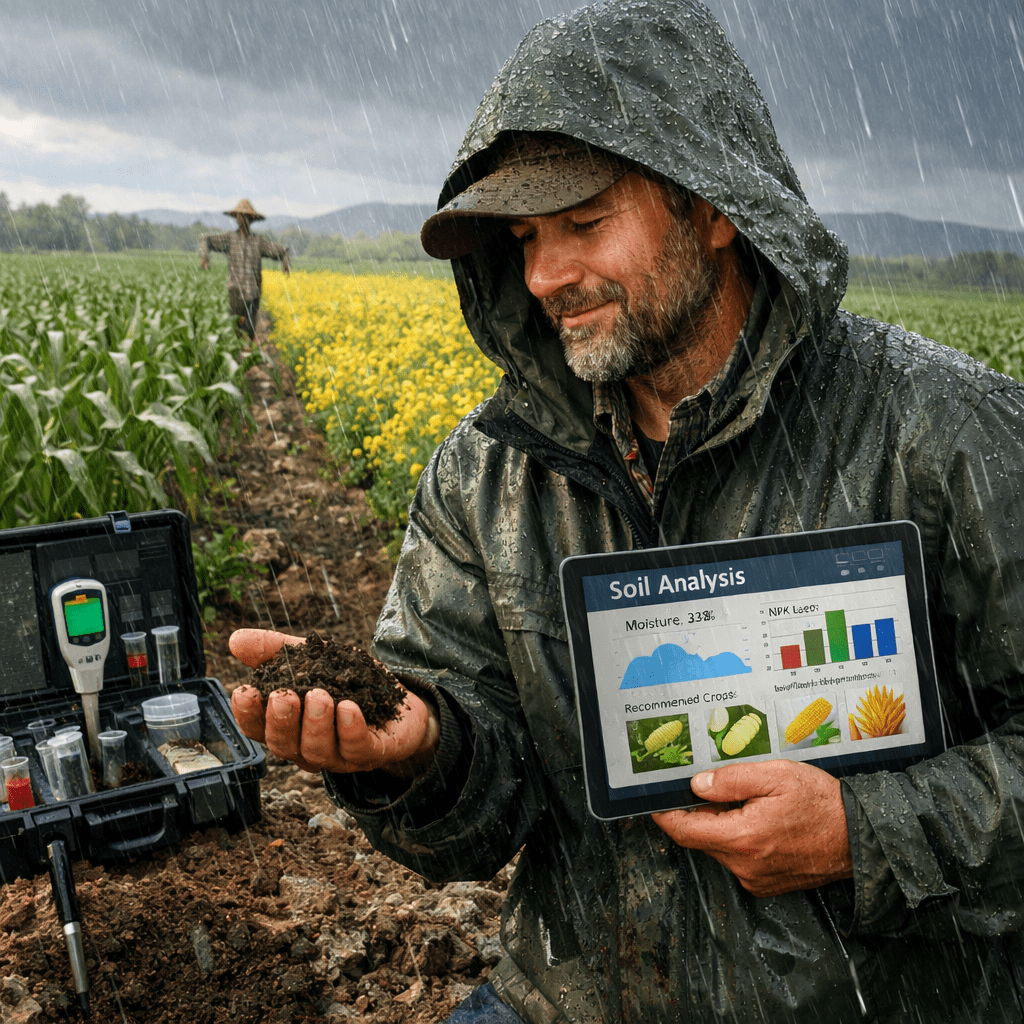
Mai arrived beside him, carrying her tablet like a field notebook. She had been working with a youth innovation group testing low‑cost soil moisture sensors built from open‑source hardware.
“Dad, we can map the driest patches,” she said. “It’s not perfect, but it’s better than guessing.”
Michael raised an eyebrow. He trusted the land more than screens. But he trusted Mai most of all.
She showed him a simple dashboard. Colour‑coded zones, moisture readings, and a predictive model based on local weather patterns.
“This is the scientific method in action,” she said. “Observe, measure, test, adapt.”
She had learned the approach from a project inspired by the CMIP climate modelling framework, which helps scientists predict how temperature and rainfall patterns will shift.
More about CMIP HERE
Michael didn’t understand the algorithms. But he understood the colours. And the colours told him the lower field would fail without intervention.
Mai knelt and pressed her hand into the soil. “It’s not about being certain,” she said. “It’s about being ready.”
Michael exhaled. He made the call about switching to the drought‑tolerant seed, adjust grazing rotation, and trial the moisture sensors for the season.
It wasn’t a perfect plan. But it was a flexible one.
And flexibility, he realised, was becoming the new inheritance.
BUILD And ACT
Activity: Build The Uncertainty Triangle
A simple activity to connect science → behaviour → policy.
Purpose
To help understand how decisions form under uncertainty and where interventions can support resilience.
How It Works
Draw a triangle with three corners:
SCIENCE (What we know)
Examples:
- rainfall projections
- soil moisture data
- climate models (e.g., CMIP)
- yield impact research (e.g., projected −22% maize yield under high‑emission scenarios)
Participants list the scientific inputs available to them.
BEHAVIOUR (How people respond)
Examples:
- risk perception
- habits
- emotional responses
- psychological flexibility
- trust in information sources
Participants identify behavioural barriers and enablers.
POLICY (What structures support action)
Examples:
- grants
- advisory services
- peer‑learning networks
- regulatory clarity
- scheme design
Participants map which policies help or hinder adaptive decisions.
Final Step – Connect the Dots
Ask participants to draw lines between the three corners:
- Where does science fail to influence behaviour?
- Where does policy not reflect scientific evidence?
- Where does behavioural reality contradict policy assumptions?
The intersections reveal leverage points – places where small changes can unlock big shifts.
 JK Studio