
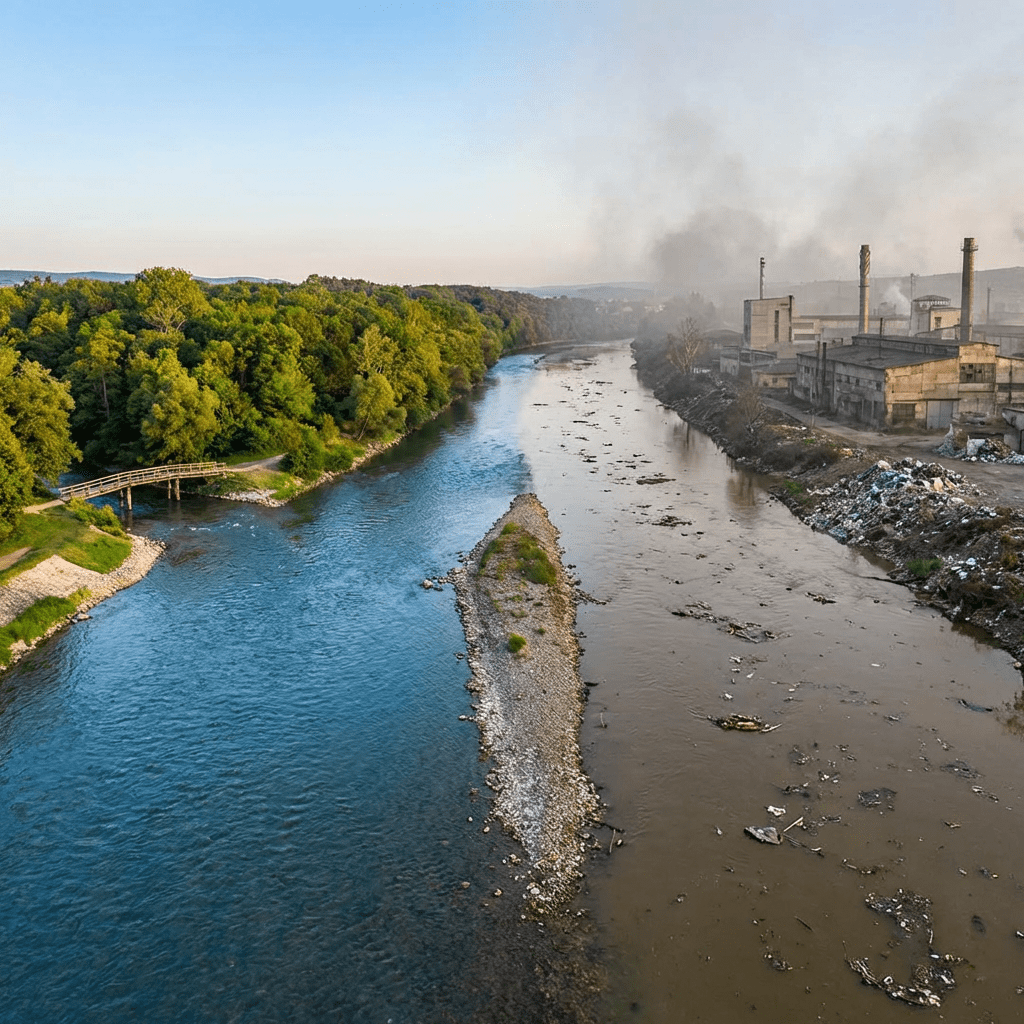
Poets are not only magical with words but, at times, with predictions too. Seeing how the world is turning, whenever I read through poems—my favourite hobby—I find myself relating to lines that stir not only empathy for Earth, our shared home, but also anger at our own behaviour.
There is a famous line by Samuel Taylor Coleridge from The Rime of the Ancient Mariner.
“Water, water, every where,
The Rime of the Ancient Mariner
Nor any drop to drink.“
Read the whole poem: The Rime of the Ancient Mariner (text of 1834) | The Poetry Foundation
Philosophically, these lines endure because they capture a universal human experience: being surrounded by what we need, yet unable to access it. The sea is vast, overwhelming, indifferent. Even though water surrounds the sailors, it is useless to them—a reminder that humans remain small and vulnerable before nature’s forces.
But today, I am making a scientific turn, taking the words almost literally.
Yes, a large part of the Earth is covered in water in all its forms. We are not lacking it. It is one of the most abundant natural resources our planet holds. Yet when it comes to fresh, drinkable water, the story changes. Only a tiny fraction is accessible for human use. And even that fraction is shrinking, not because nature is failing us, but because we are failing nature.
Where Chemistry Steps In
Water quality is not just an environmental issue; it is a chemical one. Every drop of water carries a story written in ions, molecules, contaminants, and reactions. Chemistry helps us understand:
- Why water becomes polluted (from nitrates, PFAS, heavy metals, microplastics, industrial effluents)
- How pollutants behave (how they dissolve, accumulate, or transform)
- How can we remove them, if so (filtration, adsorption, coagulation, advanced oxidation, membrane technologies)
- How ecosystems respond (pH shifts, oxygen depletion, eutrophication)
When we say “clean water,” we are really talking about chemical balance, i.e., about restoring water to a state where its composition supports life rather than threatens it.
The Paradox We Created
We live in a world where:
- Rivers run full, yet communities walk miles for safe water
- Lakes shimmer beautifully, yet hide toxic algal blooms
- Groundwater exists in abundance, yet is laced with arsenic, fluoride, or pesticides
- Oceans stretch endlessly, yet desalination remains energy-intensive and costly
It is Coleridge’s lament, rewritten in modern chemistry.
The Hope Chemistry Offers
The good news is that chemistry is not just diagnosing the problem; it is offering solutions:
- Green chemistry that reduces harmful byproducts
- Bioremediation using microbes to clean water naturally
- Nanomaterials that filter contaminants at the molecular level
- Solar-powered purification for off-grid communities
- Real-time sensors that detect pollutants before they spread
Science is not distant or abstract here. It is practical, urgent, and more human.
Water is not scarce. Clean water is. And the difference between the two lies in our choices, our chemistry, and our willingness to restore balance. If we understand the science, we can change the story.
 JK Studio